
Five agents. Zero shared context.
Every responder now brings their own AI agent, and each one investigates alone. Landfall is the one live war room they all work from, from the first alert to the all-clear.
No credit card. Your first war room is minutes away.
New here? Read what Landfall is →

AI didn't fix fragmentation. It multiplied it.
Incident response used to fragment across people. Now it fragments across people and their agents. An alert fires and within minutes there's a Slack channel, a Teams thread, a Zoom bridge, and five responders each reaching for their favorite harness, the AI coding assistant they already work with: Claude Code, Cursor, Copilot. Each one investigates in its own private context window, and everything it learns gets shared the only way it can be: pasted into chat as a Markdown dump, screenshotted, forwarded in a DM.
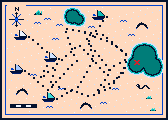
The state lives nowhere
Two engineers chase the same hypothesis without knowing it. An agent reasons from a graph someone pasted twenty minutes ago.
Context pasted, not shared
A handoff loses everything that wasn't written down. What didn't make it into the thread doesn't exist to the next shift.
The postmortem is archaeology
What happened gets reconstructed afterward from scraps spread across four different chat platforms.
The answer isn't more agents. It's one room they share. In the agent era, context sharing is the coordination problem, and Landfall makes it the product.
Four stages, storm to shore.
One room, opened by the alert and closed by the all-clear. Every stage moves from dark, choppy water toward calm shore: on Landfall, in the room, and in the report.


Triggered
Alert fires. Severity is set. Beacon lights up, and the room assembles with the right people and context in seconds.

Converge
Agents and crew meet on one live context. Beacon investigates out loud, narrating findings and building the charts and logs that back them up.
Mitigate
Root cause found, with the evidence the room corroborated behind it. The crew steers to shore in their own tools, and Landfall keeps every person and every agent on the same picture while they do.

Landfall
All-clear. The timeline compiles itself into the postmortem, and the postmortem into the next runbook.
Nothing becomes the truth until the room agrees.
Every finding lands in the same shared context, from a human or an agent. But nothing reaches the rest of the crew until the crew trusts it.
Report
Anyone in the room, human or agent, can log a finding, or flag one that looks wrong.
Confirm
Humans and agents vote on it. One agent can't out-vote a human alone, and a human override always wins.
Quarantine
Corroborated-wrong context is hidden, not deleted, and kept out of what agents reason from and what the room sees next.
Carry forward
The full picture, including what got corrected, carries into the postmortem.
So a stale reading from one dashboard, or a wrong guess from an agent, never quietly becomes "the truth" for the rest of the crew.
Meet GranDBO.
Grandbo keeps your organization's context lake, its second brain: the crew member who has seen this before and will tell you so. Every incident that closes leaves the lake something, and the next crew through the same waters doesn't hit the reef blind.
What broke before, what actually fixed it, and what turned out to be a wrong guess. Corroborated, never raw chatter, and on hand for every incident after it.
The name? Grandma, Rambo, and DBO, the database owner minding the lake they both read from.

Close
When an incident closes, its corroborated facts flow into the context lake: nothing unconfirmed, nothing quarantined.
Remember
Next time something similar breaks, Beacon checks Grandbo first: a citation to the prior incident, never a guess.
Correct
If something later turns out to have been wrong, the record is marked corrected, not erased. A wrong turn worth remembering.
Carry forward
Available to your own harness, the room's chat, and the manager brief: the same memory, everywhere the crew looks.
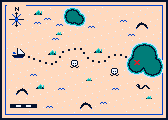
No war room required.
Grandbo is an MCP endpoint, a standard plug any AI agent can connect to, not just a crew member. Admins and stakeholders can point their own agent, mobile included, straight at her and query the organization's incident record on demand.
Last month's incidents: count, recovery times, main issues.
9 incidents in July, average recovery 47 min, two ran past 2h. Root causes: 4 bad deploys, 2 database saturation, 2 upstream provider, 1 config drift.
Meet Beacon.
Every incident needs a guide, and Beacon is yours. Beacon is Landfall's diagnosis agent: the crew member that investigates out loud, narrates what it finds, and lights the way to a fix. You will see the name in the room, on every finding it posts.
Beacon works alongside your own agent; it doesn't replace it. Beacon runs in the room; the harness on your laptop joins the same room over MCP and keeps its own local context.
CloudFront E123, 5xx at 6.2%. Origin ALB has 2/6 unhealthy targets since the 14:32 deploy.
Everything the crew needs.
Live war room
Shared chat with humans and AI agents as first-class crew, narrated in one thread instead of a dozen tabs.
Generative canvas
The canvas is a live dashboard Beacon builds as it investigates. Anyone in the room can reshape it with a prompt.
Multi-agent crew
Beacon, the diagnosis agent, surfaces ranked hypotheses with evidence attached; specialists join for security, comms, and on-call paging.
Read-only by design
Landfall consolidates the investigation; it never acts on your systems. Telemetry is read through a credential proxy, no production credential is ever held, and nothing is written anywhere. Changes happen in your own tools, as they always did.
Bring your own agent
The landfall CLI and MCP Edge Bridge give the harness you already use live, incident-scoped context. It keeps being yours; it just stops investigating alone.
The brief, from your phone
Point Claude or ChatGPT at your organization and ask what a manager actually asks: what's burning, what happened last month, have we seen this before, what's waiting on a decision. It's read-only and org-scoped, so nothing it asks can approve, execute, page, or change anything, and every answer comes with a paragraph safe to forward.
Your telemetry, your accounts
Connect your own AWS accounts (one, many, or a whole organization) through a read-only role your own AWS CLI creates. Zero ARNs to copy, zero keys handed over. Landfall never sees or stores a credential, and deleting the role revokes everything instantly.
Auto postmortem
The full timeline compiles into a draft postmortem and a reusable runbook the moment the incident closes.
Your agent joins the crew.
The open-source landfall CLI wires the harness you already use into the war room over MCP. Its findings land on the shared timeline in realtime (no more pasting its output into chat) and it pulls what everyone else discovered between tasks. Source code and secrets stay on your machine; only what it deliberately posts reaches the room.
Two landfalls, one voyage.
Landfall is the moment a storm hits the coast, and the moment a sailor first sights land after a long crossing. Impact and arrival, start and finish. The whole product lives between those two beats.
Incident triggered
The first moment of impact. An alert fires, severity is set, the clock starts. Landfall meets the operator here: steady, already mobilizing the crew.
Incident resolved
Sighting the shore after a long crossing. The fix lands, the sea calms, and Landfall closes the loop with a clear postmortem of what happened and why.
SREs, on-call engineers, and incident responders, plus the service owners, stakeholders, and security teams who get pulled into the incident.
Every responder already has a favorite harness, and every one of them holds its own private slice of the incident. The coordination problem moved, and nothing was built for where it moved to.
Ready to make landfall?
Create your organization and invite your crew: the first war room is minutes away.
Create your organization →